
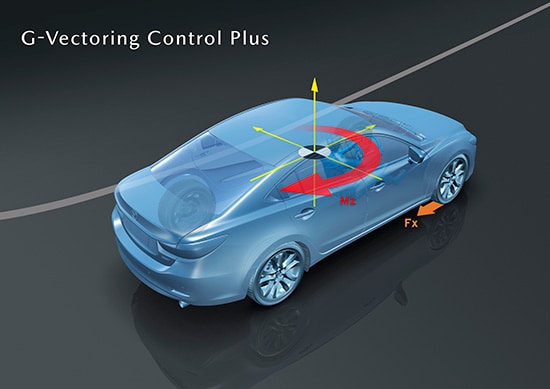
Mazda has spent years chasing one feeling: the moment a car settles into a corner instead of fighting it. That feeling comes from a system called Mazda G-Vectoring Control, one of the more overlooked pieces of engineering in the lineup. Blaise Alexander Mazda of State College gets questions about it often, so we're breaking down what it does and how G-Vectoring Control Plus takes it further.
How G-Vectoring Control Works
G-Vectoring Control slightly reduces engine torque the instant a driver turns the steering wheel, shifting a small amount of weight onto the front tires. That subtle shift improves tire grip exactly when it matters most, which is why the car feels more connected through a corner. Drivers rarely notice it working, since it operates in fractions of a second, long before the car needs any real correction.
What G-Vectoring Control Plus Adds
G-Vectoring Control Plus builds on that foundation by adding subtle braking input to the outside front wheel as the vehicle exits a turn. This additional input helps stabilize the vehicle and improve its response as steering returns toward center, including during quick transitions such as lane changes. G-Vectoring Control Plus is standard across the current Mazda lineup except the Mazda MX-5 Miata, allowing the technology to work quietly in the background on everything from sedans to crossovers.
Is G-Vectoring Control Plus Torque Vectoring?
Despite the name, G-Vectoring Control Plus isn't a traditional torque-vectoring system. Rather than distributing engine torque between individual wheels, it uses subtle adjustments to engine output and braking to influence weight transfer and help the vehicle respond more smoothly to your steering inputs. The system works automatically in the background, so you can benefit from its added stability without having to activate it yourself.
Learn More at Our MAZDA Dealership in State College, PA
G-Vectoring Control and G-Vectoring Control Plus are two examples of how Mazda engineers vehicle responses around the driver's inputs. The technology works subtly in the background, making a test drive one of the best ways to experience how a properly equipped Mazda vehicle responds through curves and steering transitions. At Blaise Alexander Mazda of State College, we're happy to answer your questions and show you which current models include G-Vectoring Control Plus.
